
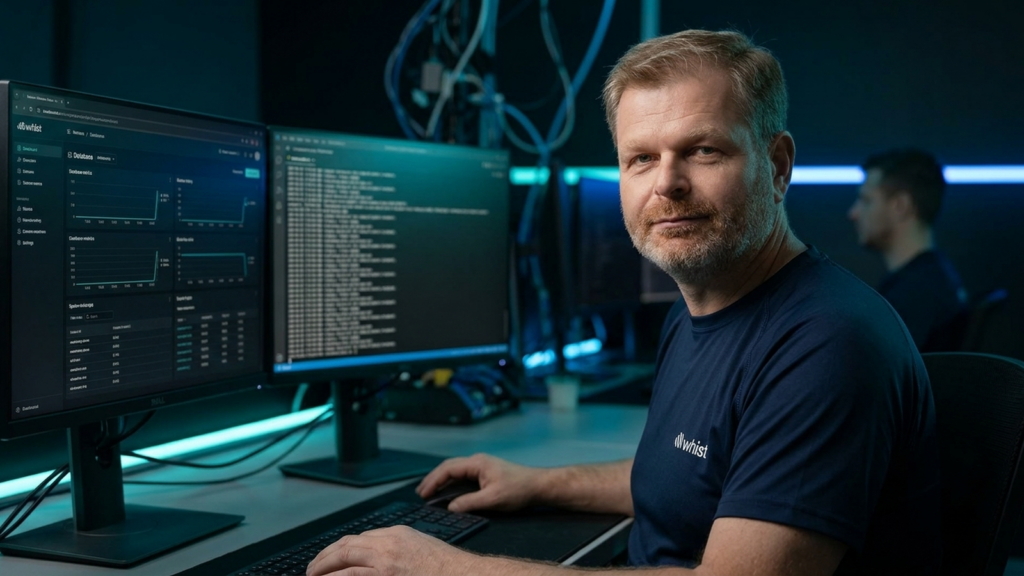
When a production database breaks at 2 a.m., the question that matters most isn’t “who’s on the support rotation tonight” – it’s “who actually knows this schema, these indexes, and these failure modes well enough to fix it fast.” That’s the gap a named senior DBA operator for hire in Israel dedicated accountability model is built to close. Instead of routing database work through a ticketing system staffed by whoever is available, you get one senior person who owns the database layer end to end, knows your environment by name, and is answerable for how it performs.
This article explains what that model actually looks like in practice, why it matters more for database work than for almost any other technical function, and how to evaluate whether a named senior DBA operator for hire in Israel dedicated accountability arrangement is the right fit for your team.
What a Named Senior DBA Operator for Hire in Israel Dedicated Accountability Model Actually Means
Most companies manage database operations one of two ways: an internal engineer who handles databases as one of six other responsibilities, or an outsourced support desk where requests get assigned to whoever is next in the queue. Both approaches work until something goes wrong in a way that requires deep, specific context – a slow query that only appears under a particular load pattern, a replication lag that started after a schema migration three months ago, a backup that silently stopped validating.
A named senior DBA operator for hire in Israel dedicated accountability engagement replaces that fragmentation with a single, identified senior professional who is responsible for your database environment specifically. Not a team. Not a pool. One named person, whose job performance is measured by the health, performance, and reliability of your databases, and who carries the institutional memory of every change made to them.
Why Database Administrator On-Call in Israel Ownership Model Matters More Than It Sounds
Databases are unusual among technical systems because the cost of lost context is extremely high and shows up in ways that are hard to reverse. A misconfigured index can be rebuilt. A corrupted dataset that nobody noticed for two weeks because the person who understood the backup strategy left the company cannot always be recovered at all.
This is why a database administrator on-call in Israel ownership model is structurally different from on-call rotations for other parts of the stack. A web server going down for twenty minutes is an inconvenience. A database replica silently falling out of sync, or a backup job that has been failing quietly for a month, can mean real, permanent data loss. The person who is on-call for your databases needs to already understand your schema, your query patterns, your replication topology, and your backup validation process – not learn it while the incident is unfolding.
That’s the practical argument for a named senior DBA operator for hire in Israel dedicated accountability setup: the person responding to an incident is the same person who has been watching slow-query logs and capacity trends for months. There is no handoff, no context-rebuilding, no reliance on documentation that is three versions out of date.
Senior Database Operations Owner in Israel Full Responsibility, Not Shared Tickets
There’s a meaningful difference between a database administrator who closes tickets and a senior database operations owner in Israel full responsibility arrangement where one person is accountable for outcomes. Ticket-based support measures success by response time and resolution count. An ownership model measures success by whether the database environment is actually getting healthier, faster, and safer over time.
In practice, a senior database operations owner in Israel full responsibility model includes things that rarely show up in a support ticket queue at all:
- Proactive index and query tuning based on patterns observed over weeks, not just reacting to a single slow query complaint
- Ongoing capacity planning so storage, connection limits, and replication lag don’t become surprises
- Backup and restore testing on a real schedule, not just confirming that a backup job “ran”
- Migration planning for schema changes that considers downstream application impact, not just the SQL itself
- Security hardening – access controls, credential rotation, audit logging – treated as ongoing work, not a one-time setup
None of that is visible in a ticket count. It’s visible in the absence of incidents, which is exactly why it tends to get skipped by teams that are measured on tickets closed rather than systems improved.
What a Named Senior DBA Operator for Hire in Israel Looks Like in Practice
In a typical engagement, the operator starts by auditing the current database environment – schema design, indexing strategy, replication setup, backup configuration, query performance, and access controls. This isn’t a generic checklist exercise; it’s meant to surface the specific risks sitting in your environment right now, many of which internal teams have grown used to and stopped noticing.
From there, the operator takes direct ownership of:
- Monitoring and responding to database performance and availability issues
- Planning and executing schema changes and migrations alongside the engineering team
- Maintaining and testing backup and disaster recovery processes
- Managing access, credentials, and database-level security posture
- Advising on architecture decisions that touch the data layer – sharding, read replicas, caching strategy
- Keeping cost and resource usage under control, especially for managed database services where usage creeps upward unnoticed
Crucially, this person stays named and consistent over time. If you talk to this provider again in eight months, you’re talking to the same individual who already knows why a particular table was denormalized, why a certain index was deliberately left off, and what happened the last time a migration went sideways. That continuity is the entire point of a named senior DBA operator for hire in Israel dedicated accountability model – it isn’t a feature added on top, it’s the core of what you’re paying for.
Why This Beats Freelancers and Overloaded Internal Teams
Freelance DBA support usually comes with a quiet tradeoff: lower hourly cost in exchange for fragmented ownership. A different freelancer may pick up each engagement, each one re-learning your schema from scratch, each one making reasonable but disconnected decisions that don’t add up to a coherent long-term strategy. For something as foundational and as unforgiving of mistakes as a production database, that fragmentation is expensive in ways that are hard to see until something breaks.
Internal teams have the opposite problem. A backend engineer who also “handles the database” is doing database work in the gaps between feature deadlines. Deep database work – the kind that prevents incidents rather than reacting to them – gets deprioritized every single sprint, because it’s rarely the loudest fire. Over time, technical debt accumulates quietly in the data layer specifically because nobody owns it as their primary job.
A named senior DBA operator for hire in Israel dedicated accountability engagement sits between those two failure modes. You get senior-level expertise without the fragmentation of rotating freelancers, and you get dedicated focus on the database layer without pulling your engineering team away from product work they’re better suited to own.
Who This Model Fits
Not every company needs this. A small team running a simple application on a managed database service with light traffic may be fine with occasional outside help. But the model makes real sense for:
- Enterprise companies running databases that are core to revenue-generating systems, where downtime or data loss has direct financial consequences
- Defense and regulated organizations where audit trails, access controls, and data integrity are non-negotiable and need a consistently accountable owner
- Fast-moving SaaS teams scaling quickly, where database performance problems tend to surface right when the company can least afford distraction
In each of these cases, the value of a database administrator on-call in Israel ownership model isn’t just technical competence – plenty of people are technically competent. It’s the combination of competence, continuity, and accountability that lets leadership stop worrying about who actually owns the database and start trusting that it’s being handled.
How to Evaluate a Named Senior DBA Operator for Hire in Israel Before You Commit
If you’re considering this model, a few questions tend to separate a genuine ownership arrangement from a rebranded support contract:
- Is there one named individual assigned to your environment, or does the assignment rotate based on availability?
- What happens during vacations, illness, or turnover – is there a documented handoff process, or does context simply disappear?
- Does the engagement include proactive work – tuning, capacity planning, backup testing – or only reactive ticket response?
- Can you speak directly with the person who would actually be handling your databases, before signing anything?
If the answers are vague, you’re likely looking at a support desk with a senior label attached rather than true dedicated accountability. A real senior database operations owner in Israel full responsibility model should be able to answer all four of those questions specifically, with names and processes, not generic assurances.
Closing Thoughts
Database reliability rarely fails loudly and all at once. It erodes quietly – a missed backup test here, an index that was never added there, a migration that technically worked but left behind a subtle inconsistency nobody caught. The only real defense against that kind of quiet erosion is sustained, specific attention from someone who is genuinely accountable for the outcome, not just the next closed ticket.
That’s the case for a named senior DBA operator for hire in Israel dedicated accountability arrangement: not a cheaper way to buy database support, but a structurally different way of making sure your data layer has an owner who actually knows it, and who stays.
FAQ
How is a named senior DBA operator different from a managed database service’s support team?
Managed service support typically handles infrastructure-level issues – uptime, failover, platform bugs – but has no visibility into your schema design, query patterns, or application logic. A named senior DBA operator for hire in Israel dedicated accountability model works inside your specific environment, understanding your data model and how your application actually uses it, which is where most real performance and reliability issues originate.
Does this replace our internal engineering team?
No. It takes database ownership off their plate so they can focus on product and application work, while staying closely coordinated with them on migrations, architecture decisions, and incident response. Most teams find this frees up senior engineers who were previously doing database work as a side responsibility.
What happens if the named operator is unavailable during an incident?
A properly structured engagement includes documented handoff processes, runbooks, and escalation paths specifically so that unavailability doesn’t mean a loss of context. This is one of the key questions to ask before committing to any database administrator on-call in Israel ownership model, since the answer reveals how seriously continuity is actually being taken.
Is this model only suitable for large enterprises?
It’s most commonly adopted by enterprise, defense, and scaling SaaS teams where database failures carry real financial or operational risk, but the underlying need – consistent ownership instead of fragmented support – applies to any team that depends on its database being reliable and well understood over time.
Comments & questions