
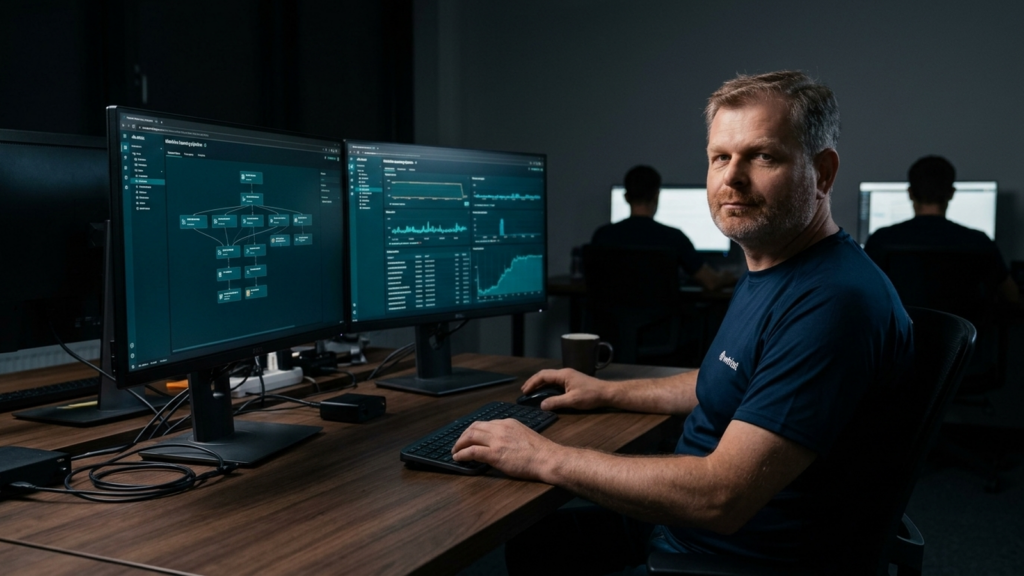
Most teams running machine learning in production don’t have an ML problem. They have an ownership problem. Models get built, pipelines get stitched together, dashboards get stood up, and then nobody is actually on the hook when a feature store breaks at 2am, a model silently drifts, or a retraining job fails three weeks in a row without anyone noticing. A named ML operator for hire in Israel solves exactly that gap: one senior person, tied to your environment, accountable for keeping ML operations running, not just for writing code.
This is different from hiring a data scientist or even a senior ML engineer to build models. It’s about who owns the operational layer once the model exists, deployment, monitoring, retraining cadence, cost, incident response, and the dozens of small operational decisions that determine whether ML actually delivers value in production or quietly rots.
What a Named ML Operator for Hire in Israel Actually Does
The word “named” matters here. It’s not a rotating pool of consultants or a ticket queue answered by whoever is free. It’s a specific, senior person who knows your pipelines, your infrastructure, your data contracts, and your failure modes, and who is accountable when something in ML operations goes wrong.
In practice, this covers:
- Owning the ML pipeline end to end, ingestion, feature engineering, training, deployment, and serving, not just one slice of it.
- Monitoring model performance and data drift, and acting on it before it becomes a business problem.
- Managing retraining schedules, versioning, and rollback procedures so a bad model push doesn’t sit in production unnoticed.
- Controlling compute and storage costs tied to training and inference, which can spiral quickly without an owner watching.
- Being the first call when something breaks, a serving endpoint goes down, predictions degrade, a pipeline job silently stops, and actually fixing it, not just escalating it.
None of this is glamorous. It’s the unglamorous, continuous work that separates ML systems that keep working from ML systems that were impressive in a demo and then quietly abandoned.
Why Teams Look for an ML Operations Owner for Hire in Israel
Three patterns show up repeatedly with the companies we talk to.
The model was built, but nobody owns what happens after
A data science team or an external vendor delivers a working model. It gets deployed. Then the people who built it move on to the next project, and the model is left running with no one responsible for its health. Drift goes undetected. Retraining doesn’t happen on schedule, if at all. This is the single most common reason teams start looking for an ML operations owner for hire in Israel, they need someone whose job is specifically to keep what already exists running well, not to build something new.
Internal engineers are covering ML ops as a side task
In many fast-moving SaaS teams, ML infrastructure ends up bolted onto whoever is least overloaded that quarter, a backend engineer, a DevOps lead, sometimes the original model author. It works for a while, until that person’s actual job expands and ML operations becomes the thing that gets deprioritized every sprint. The result is slow incident response, stale models, and rising cloud bills nobody is actively managing.
Freelancers and agencies create fragmentation
Hiring freelance ML consultants piecemeal, one for the pipeline, another for monitoring, another for cost optimization, creates a system with no single point of accountability. When something breaks across the boundary between their areas, each one can plausibly say it’s not their part. A named senior ML operator with dedicated accountability removes that ambiguity entirely: one person, one environment, one line of responsibility.
How This Differs From Hiring an ML Engineer
It’s worth being precise about this, because the two roles are often confused. An ML engineer is typically brought in to build, new models, new features, new pipelines. An ML ops operator for hire in Israel with real ownership is brought in to run what exists: keep it stable, keep it monitored, keep it cost-efficient, and keep it improving incrementally without constant rebuilding.
Many organizations actually need both, at different points. Some need an operator because they already have working models that are operationally neglected. Others need an operator precisely because they’re about to go from prototype to production and want someone senior enough to make sure the operational foundation is right from day one, rather than retrofitted after an outage.
What Enterprise and Defense-Grade Environments Need From This Role
For enterprise companies and defense organizations, the bar for ML operations is higher than “it mostly works.” These environments typically require:
- Auditability, a clear record of who changed what in a model, pipeline, or configuration, and when.
- Compliance-aware handling of training data and model outputs, especially where sensitive or regulated data is involved.
- Strict change control around model deployment, with rollback plans that are actually tested, not just documented.
- Continuity, a named operator who doesn’t disappear between contract renewals or rotate out mid-incident.
This is where the named operator model earns its keep. A rotating freelancer roster or an overloaded internal generalist rarely holds up to this level of scrutiny. A dedicated, accountable senior operator who has been embedded in the environment long enough to understand its constraints is a far better fit for organizations where ML failures carry real operational or security consequences.
What to Look For When Hiring One
If you’re evaluating a named ML operator for hire in Israel, a few questions tend to separate genuine operational ownership from a dressed-up support contract:
- Is it the same named person consistently, or does the provider rotate staff across engagements?
- Do they take ownership of outcomes, model health, uptime, cost, or just respond to tickets as they come in?
- How do they handle incidents outside normal hours, and is that covered explicitly?
- Can they show how they’d approach drift detection, retraining cadence, and rollback for your specific stack, not a generic playbook?
The answers to these questions reveal whether you’re getting accountability or just another layer of support that still leaves ownership gaps.
Closing Thoughts
ML systems don’t fail because the models were wrong on day one. They fail because nobody kept watching after launch. A named senior ML operator with dedicated accountability closes that gap by making operational ownership a job, not an afterthought bolted onto someone else’s role. For enterprise teams, defense organizations, and SaaS companies that depend on ML actually working in production, not just in a notebook, that ownership is often the difference between ML that compounds in value and ML that quietly becomes technical debt.
FAQ
What does a named ML operator actually own day to day?
They own the operational health of your ML systems: pipeline uptime, model monitoring and drift detection, retraining schedules, deployment and rollback, and incident response. It’s the ongoing operational work that keeps models reliable after they’ve been built, not the initial model development itself.
How is this different from an MLOps platform or tool?
Tools and platforms give you visibility and automation, but someone still has to interpret alerts, make judgment calls, and act when something breaks or drifts. A named operator is the accountable human behind those tools, not a replacement for a person who takes responsibility for outcomes.
Can a named ML operator work alongside our existing data science team?
Yes, and this is a common setup. Data scientists and ML engineers focus on building and improving models, while the named operator owns keeping those models running reliably in production, managing infrastructure, and handling the operational decisions day to day.
Is this model suitable for smaller SaaS teams, or only large enterprises?
It works for both, though the shape differs. Fast-moving SaaS teams often use it to avoid stretching a generalist engineer too thin, while enterprise and defense organizations use it for auditability, compliance, and continuity. In both cases, the value is the same: one accountable person instead of fragmented, rotating support.
Comments & questions