
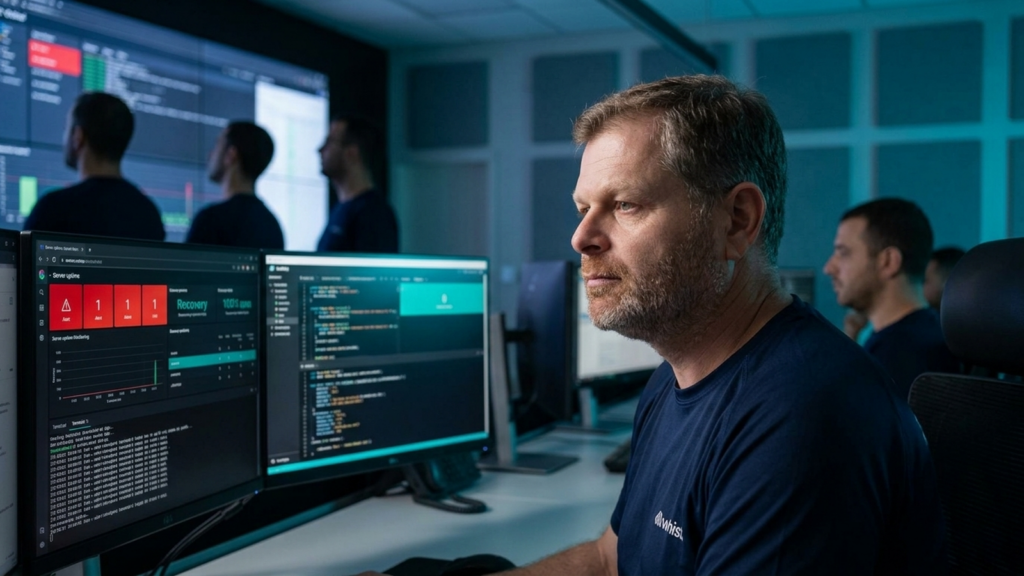
This morning, dozens of businesses across Israel woke up to the same message in their internal groups: the server fell, and every automation stopped. If you build customer flows, order confirmations, or support bots on top of a third-party WhatsApp gateway, a green api server down whatsapp automation failure isn’t an inconvenience, it’s a full stop on revenue, support, and trust, often for hours at a time.
This article explains why these outages happen, why they hit harder than most teams expect, and what actually prevents a single vendor hiccup from taking down your entire customer-facing operation.
When a Green API Server Down WhatsApp Automation Event Hits Your Business
Most teams don’t think about their messaging layer until it breaks. Green API, like any third-party gateway sitting between your systems and WhatsApp’s infrastructure, is a dependency, and dependencies fail. When they do, every automation built on top of it stops simultaneously: order confirmations don’t go out, support tickets never reach customers, reminders silently vanish, and nobody internally notices until a client calls asking why they haven’t heard back.
The pattern we see repeatedly is the same: a business built a fast, effective automation on Green API, it worked well for months, and then one morning the server went down with zero warning and zero internal plan for what to do next. A green api server down whatsapp automation incident rarely announces itself in advance. It just stops working, and the first sign is usually a customer complaint, not a monitoring alert.
Why a Single Vendor API Becomes a Single Point of Failure
Green API, and gateways like it, are popular because they’re fast to integrate and cheap to start with. That’s exactly why so many Israeli SaaS teams, agencies, and operations departments plug business-critical flows into them without a second layer of protection. The problem isn’t the vendor itself, it’s the absence of anything sitting between the vendor and your business logic that notices a failure and reacts to it.
Without that layer, a whatsapp automation server crashed event becomes your emergency, with no internal owner and no fallback path. Teams discover, often for the first time, that nobody actually owns the integration. It was set up by a developer who has since moved to other projects, or by a freelancer who isn’t on retainer anymore. When the vendor’s server goes down, there’s no one checking dashboards, no one with authority to switch providers, and no one whose job it is to tell leadership what’s actually happening.
Green API Outage Israel: What the Pattern Actually Looks Like
Reports of a green api outage israel incident tend to follow a familiar shape. The server fails during a high-traffic window, morning hours, when order volume and support requests peak. Automations queue up silently rather than failing loudly, so messages appear to be sending when they aren’t. By the time someone notices, there can be a backlog of hundreds of unsent messages, and no clean way to know which customers were missed.
This is the core risk of relying on a single external API without ownership: it’s not just that the vendor’s infrastructure is outside your control, it’s that your own visibility into the failure is just as weak. A green api outage israel event becomes a business outage precisely because nobody built the internal muscle to detect it fast and respond immediately.
What to Do When the Automation Server Goes Down
When a whatsapp automation server crashed scenario hits, most teams scramble to find manual workarounds, a shared spreadsheet, a manual WhatsApp Web session, someone copying messages by hand. These stopgaps work for an hour or two, but they don’t scale, and they don’t answer the real question: why did nobody see this coming, and why is there no fallback?
The honest answer in most cases is that the integration was treated as a one-time build rather than a piece of infrastructure that needs ongoing ownership. A monitoring check that pings the gateway every few minutes, a queueing system that holds messages safely during downtime instead of silently dropping them, and a documented failover path to a secondary provider are not exotic engineering, they’re standard DevOps practice applied to a part of the stack that usually gets skipped.
DevOps Ownership for WhatsApp API Integrations
This is where devops ownership for whatsapp api integrations changes the outcome entirely. Instead of discovering an outage from an angry customer, a named senior operator who already knows your environment is watching for it directly, alerts fire the moment the gateway stops responding, and there’s a person, not a ticket queue, accountable for the fix.
Real devops ownership for whatsapp api integrations means someone has already mapped out what happens if Green API goes down: where messages get held, how the system retries once service resumes, and at what point a secondary channel kicks in. It also means someone is accountable for that plan actually working when it’s tested under real failure conditions, not just when it’s written in a document nobody revisits.
Building Failover Before the Next Outage
The fix for a green api server down whatsapp automation problem isn’t switching vendors in a panic, it’s building resilience before the next failure, because there will be a next one. That typically means:
- Active monitoring on the gateway’s health, not reliance on customer complaints as the alert system
- Message queuing with retry logic so nothing is silently lost during downtime
- A documented and tested failover path to a secondary WhatsApp provider or channel
- A single named owner who understands the integration end to end and is accountable when it breaks
None of this requires replacing Green API or any specific vendor. It requires someone senior enough to see the integration as infrastructure, not a one-off script, and accountable enough to make sure it keeps working when the business depends on it.
Why Named Ownership Beats Freelance Fixes
Many businesses respond to an outage by hiring a freelancer to patch the immediate problem. That solves today’s incident but leaves the same exposure for the next one, because the freelancer leaves once the ticket closes, taking the context with them. A green api server down whatsapp automation failure that gets patched without ongoing ownership will happen again, usually at the worst possible moment.
Whist’s model is built specifically to close that gap: a named senior DevOps operator takes continuous ownership of the infrastructure around integrations like this one, staying accountable for monitoring, failover, and response, not disappearing after the fire is out. That continuity is what actually prevents the next whatsapp automation server crashed incident from becoming a repeat of this one.
FAQ
Why does a green api server down whatsapp automation event affect my whole business at once?
Because most teams route every customer-facing message, orders, reminders, support replies, through a single gateway with no fallback. When that one dependency fails, every flow built on top of it fails simultaneously, with no backup channel to catch the gap.
Adding a secondary path and real monitoring is the only way to break that single point of failure.
Is a green api outage israel incident something Green API will fix on their own?
Eventually, yes, vendor outages typically resolve on their own timeline, which you don’t control. The real question is what happens to your messages and customers during that window, which is entirely within your control if you’ve built queuing and failover in advance.
What should we do right now if our automation server crashed?
Check whether messages are queuing or being silently dropped, switch to a manual or secondary channel for anything time-sensitive, and document exactly when the failure started and what was affected. Afterward, treat it as a signal to build real monitoring and failover rather than hoping it doesn’t happen again.
Do we need a full-time DevOps hire to prevent this, or is that overkill?
Most teams in this position don’t need a full-time hire, they need a named senior operator who already understands their environment and takes ongoing accountability for it, without the overhead of a full internal headcount. That’s the gap a dedicated, accountable technical owner is built to close.
Comments & questions